
Behind the Scenes of My First Alien RPG Campaign
Two months ago, I finally ran the playtest for my first Alien: The Roleplaying Game campaign.
I grew up with Alien, so I wanted to build an experience that did it justice.
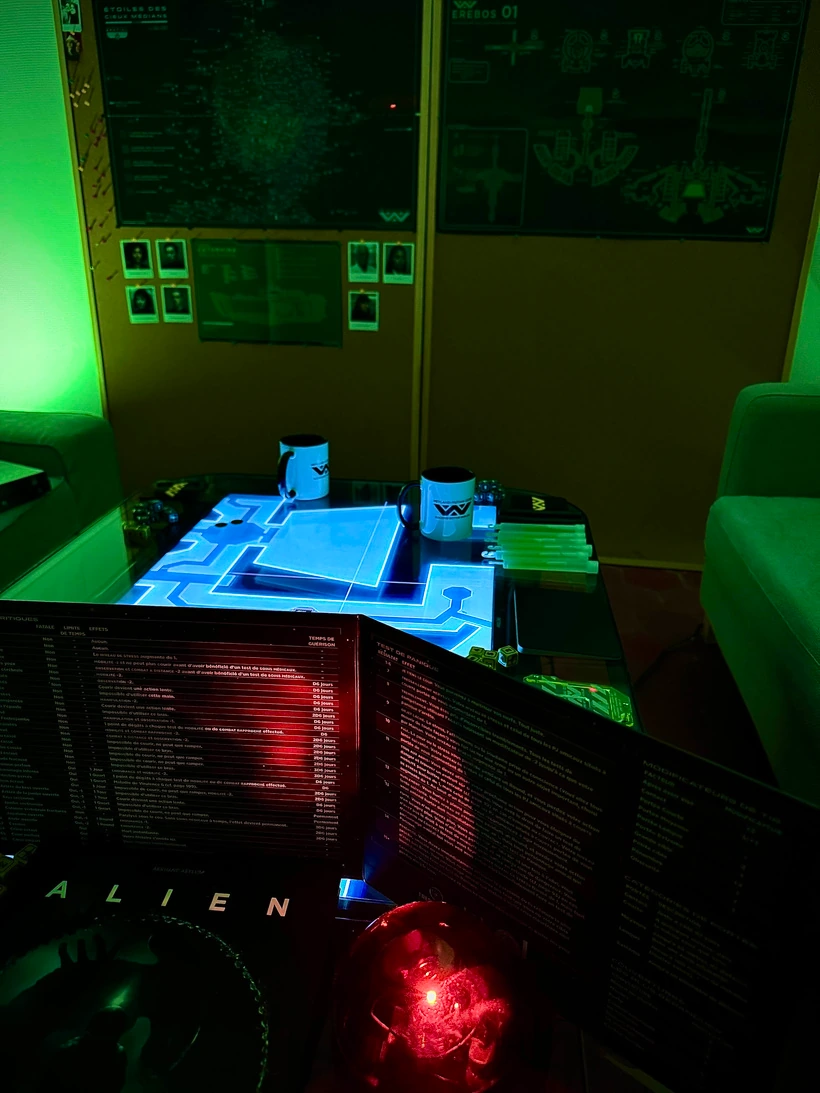
I wrote a full three-act story, reused and rewired Heart of Darkness, developed a custom motion tracker app, built a small co-op web mini-game, drew maps for the Ludic Field map viewer, set up a TV for visuals, recorded the sessions with five microphones, programmed lights, and filled the table with props.
The campaign supports three to five players. We tested it with four and played for 28 hours across three days. It was exhausting. It was absolutely worth it.
Here’s the full breakdown of how I prepared it, what we tried, and what I learned. And what’s next for Ludic RPG.
TL;DR
- In Alien, the films already created the tension. The table setup delivers the payoff
- Clichés are anchors. Use them first. Surprise comes from player interaction
- Freedom isn’t enough. Without structure, everything drifts
- More pressure doesn’t create momentum. It freezes the game
- Stretch Alien too long and the tension fades. It works best in short, intense bursts
- Mini-games are spice, not the meal. Use them sparingly or they lose their impact
- I will be focused on fixing and releasing the motion tracker on iPhone and Android
- I will also rewrite and fix my campaign and release it
Cinematic DNA: Designing for Memory
Alien was born in movie theaters.
Its identity is cinematic. You remember it through cult scenes: shadowy corridors, the chestburster, the motion tracker’s nervous beep, an android leaking white milk, pulse rifle fire lighting the dark, resin-dripping hive walls, rows of eggs in the mist, silent cryotubes. Alien lives in images and sounds before it lives in rules or lore.
The cinematic campaign mode proposed by Alien RPG already embraces that film heritage. Investing heavily in the table setup became my way of doubling down on that approach. I used the physical space to reactivate the players’ memory of the films and let it carry part of the tension. I wanted the whole experience to feel unmistakably like Alien rather than generic space horror.
You can theme a table for any RPG. A pirate game gets ropes and sand. A cyberpunk game gets neon and synth music. In Alien, it goes further. Players already remember the films. The table just triggers those memories. You’re not decorating the table. You’re delivering the payoff.
So from day one, I knew I wanted to work the lighting, the sound, and the visual props, digital or physical, and script them tightly around the scene instead of just dropping decoration on the table.
But leaning into that strong IP also revealed another challenge.
Catch-22: The Name of the Game
Because Alien is so iconic, everyone already knows it. The same movie memory I rely on for immersion also works against me.
The moment you say you’re running Alien, expectations lock in. Players arrive with decades of movies and pop culture.
They recognize the warning signs and start reading the scenario ahead of time. Despite their best efforts to separate player knowledge from character knowledge, that anticipation leaks into play. It poisons the tension.
You can try to subvert those expectations. For a first campaign or a one-shot, that’s risky. Remove the xenomorph and people might feel robbed, like they signed up for Alien and got something else entirely.
Those elements are part of the promise. Remove them and it stops feeling like Alien. Include them and the mystery shrinks.
Faced with that paradox, I needed a setting that could satisfy expectations while preserving mystery.
Strong Foundations: Rewriting Heart of Darkness
Months before the campaign, I asked my players what kind of Alien story they wanted to play: civilians, marines, or mercs.
They chose civilians.
Among the existing modules, Heart of Darkness already offered a strong foundation: a lone station at the edge of civilization, anchored to a roaring black hole, a compelling crew, and large detailed maps.
What it lacked was a xenomorph.
Because the scenario is tightly crafted and also part of a larger campaign, inserting one would have broken the structure. So instead of patching it, I rebuilt it.
I kept the station and the crew, and wrote an entirely new story around them. Backgrounds were adjusted. Personal agendas were rewritten. The setting stayed. The threat changed.
Adding the xenomorph fulfilled the expectation. It also guaranteed the anticipation problem.
Fight Fire with Fire: Using the Metagame
If anticipation was inevitable, it had to become part of the design.
The first act followed every familiar beat: a civilian crew in hypersleep, a distress beacon in the middle of nowhere, a suspicious desert moon, Mother forcing the detour, the exploration of a half-crashed ship.
It looked exactly like the beginning of an Alien film. The players felt like they were already inside a story they knew by heart.
I reused the same approach later in a key scene. Through a fogged greenhouse window, they saw blurred shapes opening in the shadows. Petals unfolding. A heavy smell.
They were convinced it was eggs. It was just flowers.
Their anticipation did the rest. They overreacted, jumped at nothing, and turned the moment into both tension and dark comedy. It became one of the most memorable scenes of the campaign.
The Unspoiled Player: Knowledge Asymmetry
One of my players had never seen the movies. He only knew Alien through pop culture fragments.
He took everything at face value. His reactions felt genuine and instinctive. The other players’ anticipation took away some of that raw experience.
In some scenes, he would react immediately, on instinct. The others would slow down, warned by a kind of “movie code” he didn’t know. It wasn’t only about metagame optimization. Sometimes it was just a joke or a reference to a famous scene. But it still broke the moment, and it sometimes isolated him a bit.
Knowledge gaps and asymmetry at the table matter. Mixing familiarity levels creates friction. It can be interesting, but it changes the kind of game you’re running. If I can, I’d rather run a table full of newcomers than mix them with veterans of the setting.
My biggest mistake: Too much pressure, freeze the game
I’m not very experienced with PvP-style play. It happened before, but actively building conflicting personal agendas into the scenario, and treating them like mechanics, was probably a first for me.
My initial thought was simple. Everything is about tension and pressure until the big xenomorph reveal. So I built the main storyline to ramp that up. Then I added personal agendas as a second source of pressure, hoping it would stack on top.
This was a big mistake.
First, players became extremely focused on their own agenda. I should have introduced them differently, or softened that focus.
Second, I gave one agenda per character, with some alliances and shared goals. It was simply too much. By trying to distribute the spotlight equally, I diluted the fun instead.
Third, there was no real structure. I placed “anchors” where agendas could connect to the main story, but they were passive. That wasn’t enough. It needed proactive structure from my side. Not optional opportunities, but real crossroads that forced decisions.
By act three, the pressure was too high and almost impossible to control. Players split off and followed their own agendas, and everything drifted.
So I’ll slightly rewrite act two, and fully rebuild act three.
Thanks to my players’ direct feedback after the session, we spotted the issue immediately and already have a few solid fixes.
I also need to adjust most of the personal agendas. This part will actually be fun. Some of them should stay light and personal, not big, plot-driving goals.
The motion tracker smartphone app: a huge win with the struggle
The motion tracker app did the job. It landed perfectly. The sound from the movie. The pulse. The tension. My players immediately bought into it.
From the GM side, it’s another story. The admin panel is tedious, and at the core I need a better way to calibrate my device with the players’ devices.
Right now the app relies on each phone’s magnetic north, using the compass as a reference. I knew it wouldn’t be perfectly accurate indoors. It drifts with electromagnetic noise, Wi-Fi, metal, all of that. According to the specs, I expected something like ±10°.
In practice, the drift was much worse. Sometimes the echo on the radar was simply way off.
With a few years of GMing behind me, I kept my composure so the players didn’t notice. It even surprised them and added tension. For me, it was a small nightmare.
Fun fact: during a stress roll, I quickly made one of the players lose the motion tracker. I pretended to roll on a table and ruled that it slipped and broke. All the players loved the props, they were genuinely disappointed. For me, it was one less liability to manage.
I’ve been thinking about it for a few weeks, and I think I found a trick. But it still needs testing.
Despite all of that, it probably had a bigger impact than I expected. So I’m going to spend the time fixing the app, porting it to Android, and releasing it properly. It’s worth it.
The Ludic Field map viewer on the table setup
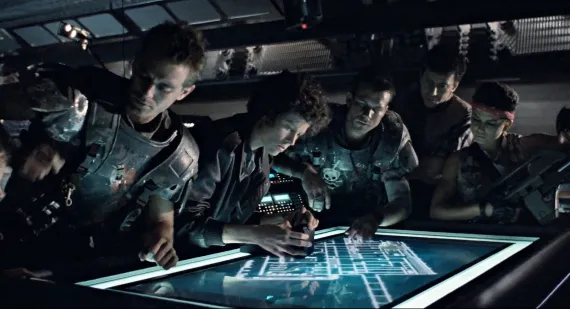
This setup is still under heavy development, but even in its current state it made a big difference for displaying and navigating the map.
I basically slapped a trackpad next to the screen so the players could explore it themselves. It instantly recreated that scene in Aliens where Hudson, Ripley, and Hicks plan over the digital blueprint of the station.
It fits the setting incredibly well, and it made navigation on the very complex Erebos map much easier.
Of course, it’s still missing a lot of features to feel truly smooth.
This project will keep going. It’s a big one, and I’ll keep adding features. The public devlog starts with how Ludic Field grew out of that single Alien map.
The Weyland Yutani coop mini-game app
If you’re curious:
(instead of mobile).
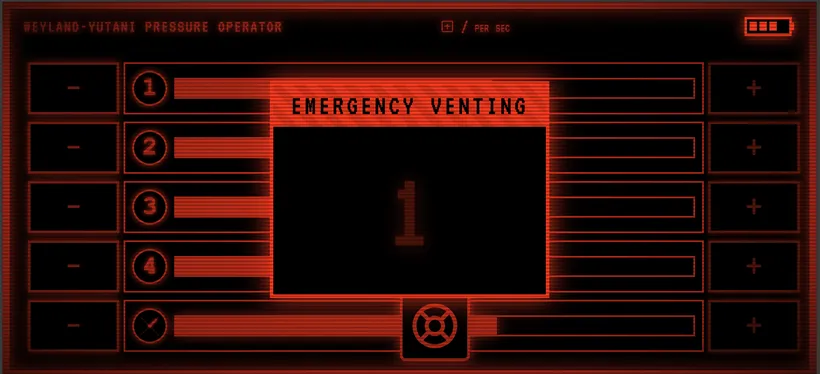
I developed a small 4-player co-op mini-game using four phones, one per player. It represents a collaborative operation where a scientific team places sensors or beacons in the field.
Technical expertise in RPGs is often abstract and a bit dull. You roll a die, add a number, and move on. But the crew in Heart of Darkness is a scientific expedition, on a scientific mission. I wanted that part of the story to feel tangible in act two, to materialize the actual work they were supposed to be doing.
Of course, neither me nor my players have a PhD in this fictional universe. So it felt like a good opportunity to turn that into gameplay instead, and at the same time bring that old retro-futuristic CRT look of Alien into their hands.
It was also a nice change of pace during a long weekend of tension and horror.
I wouldn’t say it was amazing. But according to my players’ feedback, it was nice and different.
Still, it’s not something you can use every session. If you overdo it, it becomes just as dull as rolling dice.
Minor issues
The game is web-based. Players scan a QR code and land directly in their operator console. On some phones, the browser UI (address bar, tabs) takes almost 30% of the screen in landscape mode, which ends up hiding part of the controls.
It’s also fixed to four players. It doesn’t adapt to three or five. I’m not sure I’ll publish this mini-game yet. As it would require:
- a proper port to Android and iPhone app, and a real release
- a revision of the game loop to support different player counts
Opinions about Alien RPG
It’s a blast. GM’ing in this setting was a childhood dream come true, and I can’t thank Free League Publishing, all the contributors, and the communities enough for making it possible.
That said, I probably won’t run it regularly. Alien suffers a bit from its own name, and I’m not that interested in exploring anything beyond the original trilogy or quadrilogy.
I can’t really stretch the tension over a long campaign where players meet a xenomorph or one of its variants around every corner like it’s just another regular at the bar. And if I want to run space mercs, other games can already do that. I don’t specifically need the Alien setting for it.
Short bursts of Alien are where it really shines.
I really liked the first edition system. The stress system works well, and even the supply mechanics do their job. Some of my players disagreed, though.
- Getting a success only on a 6 (on a D6) can feel unfair. Players throw a fistful of dice and still fail. The number of dice promises something big, but the result doesn’t deliver.
- The stress system can be frustrating, so as a GM you have to constantly balance it
What’s next for Alien
- Keep improving the motion tracker app and release it
- Rework the campaign and release it, and write a full tutorial how I ran it with my complete setup.
- I will run a remixed version of Act 1 as a standalone scenario for another table pretty soon
- Try to edit the session recordings (audio only) and maybe publish something, though that’s a longer-term project
What’s next for Ludic RPG
- Right now, I’m starting to GM a regular table on my favorite game “Retrofutur”, very intimate, low prep, narrative and improv focused
- Contribute to a friend’s dark medieval fantasy homemade RPG, mainly on the lore side
- Keep working on the Ludic Field map viewer and editor
- Work on a smart lights and audio automation system for RPG
If you’re curious, have questions, or just want to stay in touch, feel free to join the Ludic Discord.