
The small joy of UI motion
Today I polished the big cleanup on both of my projects: the viewer Ludic Field, and the map editor Ludic Blueprint. If you have any ideas or feedback about the name, drop them in the comments.
While working on the editor, I spent some time making the UI friendly for the Game Masters who will use it. I’m a bit obsessed with good HMI (Human-Machine Interface) design. So of course, I started adding small animations to give feedback to the user.
Designing feel, not looks
It’s all about moving things without the user seeing them move. The motion should feel organic, natural, fast, almost invisible. But those tiny motions still need to communicate both understanding and emotion. They translate into signal and feeling.
Working with motion is messy. It’s a lot of iteration. You have to work at very slow speed to fine-tune timing and sequencing, but you always have to preview everything at real speed, because the feeling can be counterintuitive. The human eye and brain have limits in how they perceive motion, and small changes in speed can completely transform what you feel.
Like any creative job, you spend minutes or hours looping the same sequence again and again. You replay it dozens, sometimes hundreds of times, and eventually you tunnel-vision. You start anticipating the preview, and that repetition builds bias. It’s also very easy to keep adding more and more movement, just because it starts to feel boring to you after so many replays.
There’s a quote from Albert Einstein that always comes to mind:
Everything Should Be Made as Simple as Possible, But Not Simpler
It applies to everything. And in design, it’s often what separates good from great.
A secret sauce of motion is acceleration. Getting the movement right is only the first step, but it means nothing without the pacing of the motion itself. Acceleration, deceleration, or a combination of both: the famous ease-in, ease-out. But never trust the template or the default settings. Adjust everything manually. Tweak every curve until it feels right.
Everything affects pacing. Is it a big or small distance? A simple or complex transformation? Each case needs its own acceleration settings. That’s what makes motion feel natural and alive.
Back to the beginning
While working on these animations, I started to feel nostalgic. It reminded me where I started.
I began my journey in UI design with Macromedia Flash. I was self-taught, around 15, and thanks to the early internet I somehow got my hands on Flash 3. That was huge for me. Before that, I was experimenting with CorelDRAW and Paint Shop Pro, probably from those CDs that came with paper magazines. You know, the ones full of demos and trial versions. I used to install everything I could find and try it all quietly at home. I barely spoke English back then, so I think I learned most of it through those software interfaces.
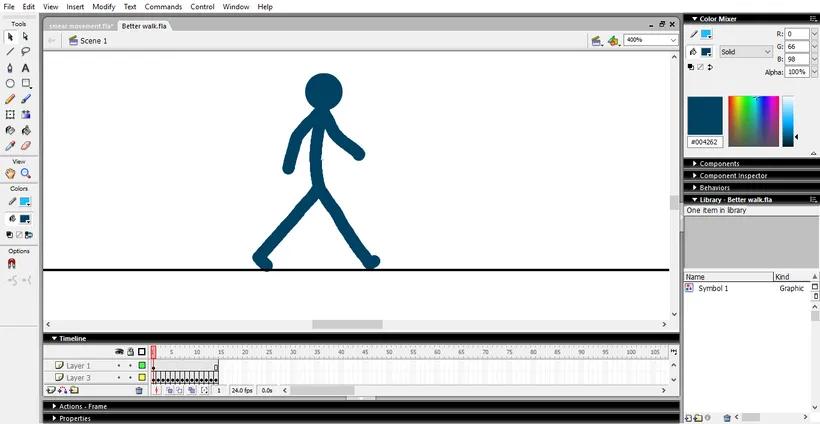
Flash felt like magic.
The timeline was intuitive, even if I didn’t really know what I was doing. I started drawing my first vector illustrations and making stop-motion-style animations, redrawing each frame. Then I discovered interpolation and realized that vectors were math, not pixels. That math could move shapes smoothly and make drawings come alive.
I became a big fan of FWA (Flash Web Awards), a website that showcased the best Flash projects in the world. It was like Dribbble before Dribbble. My internet connection was slow, so I’d wait for projects to load, then replay them for hours, trying to figure out how everything worked. I learned by reverse-engineering effects, one by one.
Over time, I developed a strong taste for animation. From small UI effects to cartoon-style movement, then later 2D game animation. I made tons of projects for myself, for online friends, and for gaming communities. It was also the early age of esports, and I had a foot in that world too, mixing my love for games and motion.
Full circle
That small portfolio eventually launched my career. One day, someone found my work and offered me my first paid gig. That’s when I realized I could actually live from what I loved doing.
That first job started my design life. I’ve lived a few others since, and none of them look much like what I’m doing now.
Back to now. I could spend endless hours tweaking and enriching these animations, but time is precious, and I need to stay balanced as I move into the complex features ahead. Next, I’ll be exploring procedural generation. I know nothing about it, so it’s probably a road to failure, and the best way to learn.
Also, if you have any questions or want to chat more about the random topics I share here, feel free to join the discord, It’s very casual over there, and I’d be happy to discuss things with you.